


PDF Version -Why Wealthy Families Choose Foundations
Executive Summary
For multi-generational Texas families managing substantial wealth, the choice between a private foundation and a donor advised fund (DAF) is among the most consequential decisions in a philanthropic plan. Whether your family's roots are in ranching, energy, real estate, or business, the legacy you have built deserves a giving structure equal in permanence and purpose. While donor advised funds offer convenience and immediate tax efficiency, private foundations provide something that cannot be replicated: institutional control, family identity, and the capacity to act as a fully autonomous philanthropic enterprise.
At Burrows Capital Advisors, we consistently find that Texas families with long-term charitable vision and the assets to sustain it benefit most from the unique advantages that a private foundation affords.
The Philanthropic Landscape for Significant Wealth
The distinction between foundations and DAFs becomes most pronounced above the $5 million threshold. Below that level, a DAF's simplicity and cost-efficiency are often compelling. Above it, however, the calculus shifts materially. Families begin to value the attributes that only a private foundation can deliver:
• Perpetual institutional identity bearing the family name
• Unrestricted investment authority over the charitable corpus
• The ability to hire staff, make program-related investments, and support causes across Texas communities
• A formal governance structure that educates and unifies generations
• Complete transparency into grantmaking strategy and outcomes
Key Advantages of the Private Foundation
1. Absolute Governance and Control
In a donor advised fund, the sponsoring organization (typically a financial institution or community foundation) retains legal ownership of the assets. Donors hold advisory privileges, not legal authority. Grant recommendations can, in principle, be declined, and investment options are limited to the sponsor's approved menu.
A private foundation is governed entirely by the family. A self-appointed board of directors, typically comprising family members and trusted advisors, holds full fiduciary authority. There are no intermediaries between a family's philanthropic vision and its execution.
2. Investment Flexibility and Wealth Stewardship
Foundation assets can be managed with the same sophistication applied to the family's investment portfolio. Families may pursue impact investing, direct private equity in mission-aligned ventures, real estate, or alternative strategies. Program-related investments (PRIs) and mission-related investments (MRIs) allow charitable capital to work harder while fulfilling the foundation's tax obligations.
Donor advised fund sponsors restrict investment options to a curated set of mutual funds, ETFs, or managed accounts. For families accustomed to institutional-quality investment management, this constraint is often unacceptable.
3. Grantmaking Across Texas and Beyond
Private foundations may make grants to virtually any qualifying organization, including Texas nonprofits, university scholarship funds, faith communities, rural health clinics, food banks, and organizations yet to receive 501(c)(3) status, provided appropriate expenditure responsibility protocols are followed. For Texas families, this means the freedom to invest deeply in the communities where their wealth was built.
DAF sponsors typically restrict grants to IRS-recognized public charities and may require additional review for smaller or newer organizations. For families who want to back a startup food pantry in East Texas, fund a West Texas water initiative, or endow a scholarship at a Texas university, a foundation provides the flexibility a DAF simply cannot match.
4. Family Legacy and Institutional Identity
A private foundation bearing the family name becomes an enduring Texas institution. It can operate in perpetuity, growing in prominence with each passing generation. Some of the most respected philanthropic names in Texas, from the Meadows Foundation to the Moody Foundation to the Amon G. Carter Foundation, trace their origins to a single family's decision to build something lasting.
A donor advised fund, by contrast, carries only an advisory name. The institution itself belongs to the sponsor. Future generations inherit an account, not a legacy.
5. Governance as a Family Unifier
Sophisticated families use the foundation as a formal vehicle for multi-generational engagement. Board governance, grant committee participation, and site visits to funded organizations give younger family members meaningful responsibility and exposure to the family's values, often years before they inherit financial assets.
The structure instills shared purpose. Our Texas clients regularly cite the foundation board meeting as one of the few gatherings where all branches of an extended family, spanning cities, ranches, and time zones, consistently convene around a common mission.
6. Operational Capacity and Programmatic Impact
Foundations may employ professional staff such as a program officer, grants manager, or communications director, allowing families to engage with issues at an operational depth that a DAF cannot support. Foundations can convene conferences, publish research, co-invest with other philanthropies, and become recognized voices in their chosen fields.
Side-by-Side Comparison
The following table summarizes the primary structural differences between private foundations and donor advised funds:
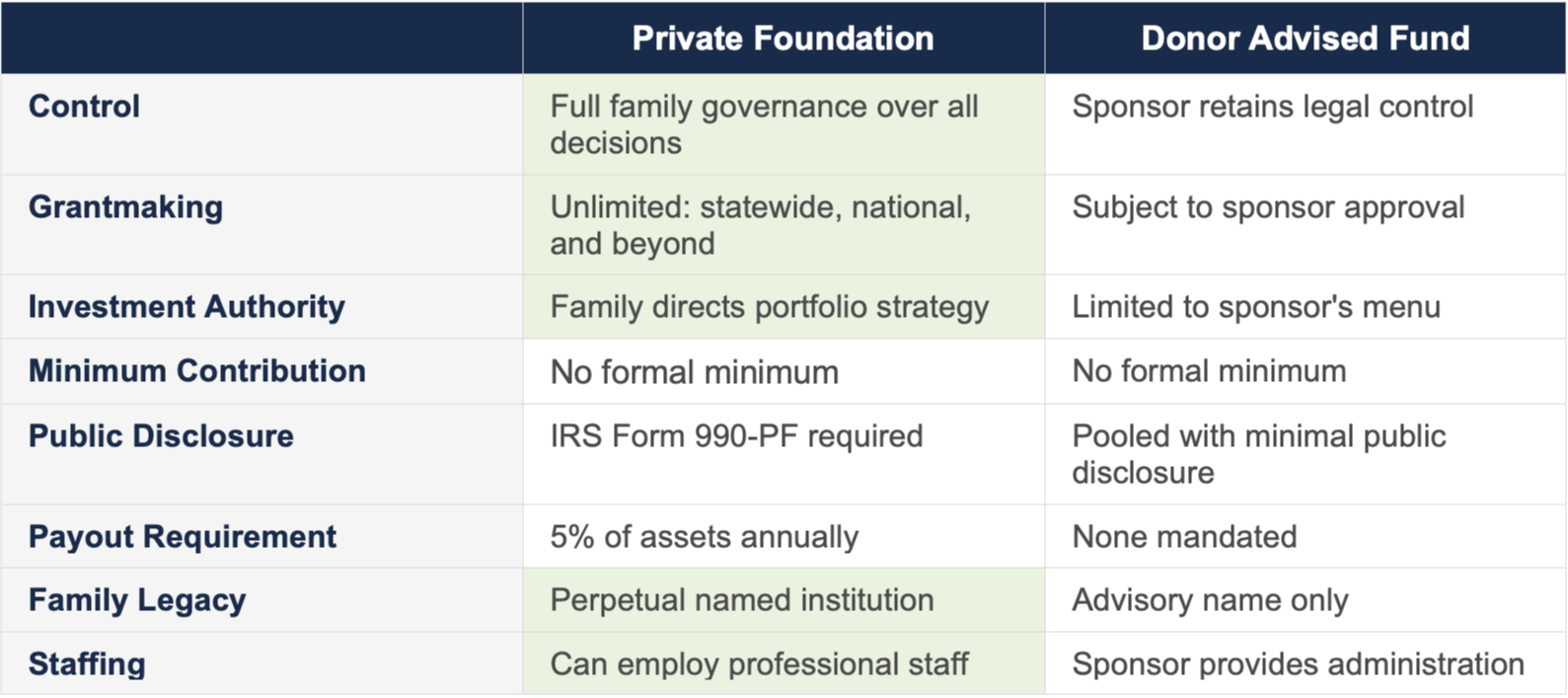
† Highlighted cells indicate the preferred option for families seeking maximum philanthropic impact and control.
Acknowledging the Trade-Offs
Intellectual honesty demands that we acknowledge the real costs of foundation formation and operation. Families considering this path should be aware of the following:
• A lower charitable deduction ceiling: 30% of AGI for cash contributions (versus 60% for DAF contributions)
• Annual administrative costs: legal, accounting, tax filing, and potential staffing expenses
• A mandated 5% minimum annual distribution of net investment assets
• Public disclosure obligations through Form 990-PF, which is publicly searchable
• More complex formation process, typically requiring three to six months
For families with significant charitable intent and the assets to justify the operational investment, generally $5 million or more, these trade-offs are routinely absorbed. In many cases, families choose to maintain both structures: a private foundation for their strategic, long-term grantmaking, and a DAF for tactical, rapid-response giving.
The Burrows Capital Approach
Rooted in Texas and built to serve Texas families, our philanthropic advisory practice is founded on the belief that charitable strategy should be as disciplined as investment strategy. We work alongside families across the state to design philanthropic structures that reflect their values, honor their heritage, and maximize their impact in the communities they care about most.
Our services in this area include:
• Foundation formation, governance design, and investment policy development
• Trustee and board education programs for multi-generational families
• Grantmaking strategy and program area prioritization
• Integrated philanthropic and estate planning in coordination with family counsel
• Ongoing investment management of the charitable corpus
We invite Texas families exploring these questions to engage with our team. The conversation about purpose, land, and legacy is among the most meaningful we have the privilege of facilitating.
Don Burrows | Founder, Managing Partner & Financial Advisor, Burrows Capital Advisors
Don Burrows founded Burrows Capital Advisors to serve families for whom wealth is not an end but a means — a platform for legacy, purpose, and enduring impact. With decades of experience advising high-net-worth and ultra-high-net-worth families on integrated financial and philanthropic strategy, Don brings a practitioner's perspective to the intersection of capital stewardship and charitable mission.
IMPORTANT DISCLOSURES
This client note has been prepared by Burrows Capital Advisors, LLC. for informational and educational purposes only. It does not constitute legal, tax, or investment advice and should not be relied upon as such. The information contained herein is based on sources believed to be reliable but is not guaranteed as to accuracy or completeness. Tax laws are subject to change, and the applicability of any strategy depends on an individual's specific circumstances. Burrows Capital strongly recommends that clients consult with qualified legal and tax advisors before establishing any philanthropic structure.
Donor advised funds (DAFs) are charitable giving vehicles administered by a sponsoring public charity. Contributions are irrevocable, and the sponsoring organization retains legal control over donated assets, while donors may retain advisory privileges regarding investment and grant recommendations. While DAFs may provide certain tax advantages, including an immediate charitable deduction, tax benefits depend on individual circumstances and applicable IRS rules.